



















How to Choose the Right Pillow Height: Practical Guide (Down, Fiber, Anatomical and Core)

In one sentence: the right height is the one that keeps head–neck–spine “aligned” in your sleeping position, taking into account your shoulders, mattress firmness and the pillow material.
Golden rule: “aligned” beats “high/low”
A pillow is right when, in your position, your head doesn’t drop either upward or downward: your neck stays neutral (without twists or obvious bends).
Recommended height by sleeping position: a table that really works
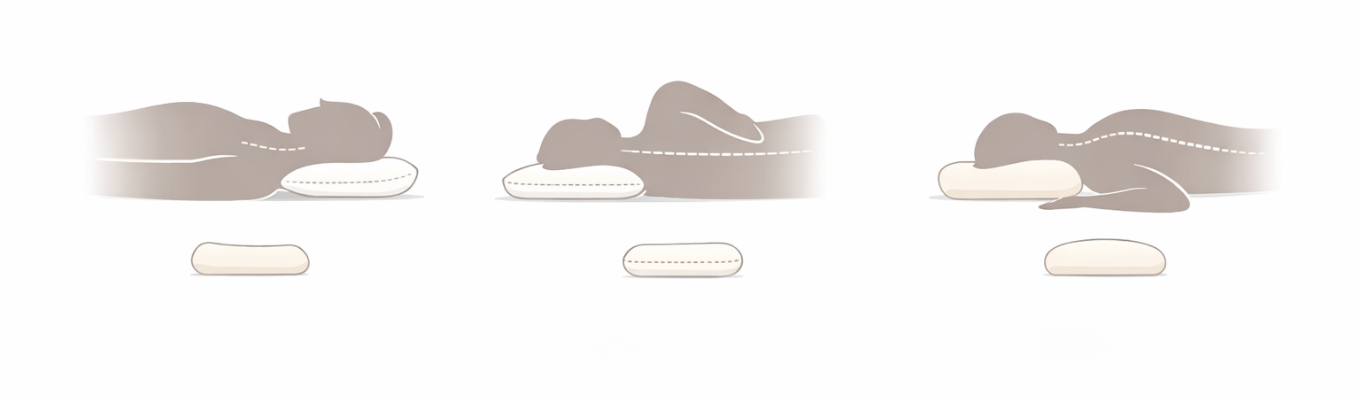
Important note: the measurements in cm are guidelines and depend on shoulders + mattress + material (which compresses).
| Main sleeping position | Recommended height | Why |
|---|---|---|
| Back | About 10–12 cm | It should support the natural curve of the neck without lifting the head too much. |
| Side | 12–14 cm (up to ~15 cm if you have broad shoulders/a firm mattress) | It should fill the space between shoulder and neck, keeping the head parallel to the mattress. |
| Stomach | 6–9 cm (or even less) | Too much height increases neck rotation/extension. |
How to “self-test” the right height in 60 seconds (no tools)

1) The line test (side sleeping)
Lie on your side as you usually do.
- If your chin “drops” toward your chest → the pillow is too high.
- If your head “falls” toward the mattress → too low.
- Goal: head and neck in line with the spine.
2) Shoulder + mattress test (the trick that changes everything)
- Soft mattress: your shoulder sinks more → you often need a slightly lower pillow.
- Firm mattress: your shoulder sinks less → you often need a higher pillow (especially on your side).
(It’s the same principle as the “space to fill” between shoulder and neck.)
3) The “two positions” test (for restless sleepers)
If you switch between side and back, it usually works better to choose:
- a medium height (about 11–13 cm) or
- an adjustable pillow (modifiable filling).
Height “at rest” vs height “in use”: the most common mistake
Many people look at the stated height, but every material compresses differently:
- down tends to “give” and shape itself,
- some synthetic fibers may lose volume faster,
- some natural fibers behave very differently from one another.
Differences between DaunenStep types (and how they affect height)
1) Down pillows
How they behave: soft, compressible, “adaptive” (they shape to pressure).
- Pros: natural comfort, a cozy, enveloping feel; breathable and hygroscopic; available in different heights.
- Cons: if you’re looking for very “firm” support, perceived height may vary (down settles and needs fluffing).
- Key height detail: the down/feather mix changes “support”: more small feathers = generally more support; more down = more softness.
Height in practice
- Back: a medium-low option is often excellent (gentle support).
- Side: better a more supportive or “higher” fill to fill the shoulder–neck gap.
2) Fiber pillows (microfiber / “down-effect” fibers, e.g. PrimaLoft® Bio™)
How they behave: lightweight and practical; fiber tends to provide more “uniform” and predictable support.
- Pros: easy care; many solutions focus on hygiene and washability; some fillings are designed with a down-like feel and good breathability.
- Cons (typical): over time some fibers can lose volume and become “flatter” (depending on quality and maintenance).
Height in practice
If you choose fiber, prioritize:
- fiber with good shape recovery;
- evenly distributed filling (that doesn’t shift);
- if available, volume adjustment (to fine-tune height over time).
3) Anatomical pillows (ergonomic, e.g. memory foam / polyurethane foam)
How they behave: designed to guide posture—more “structured” support than down/fiber, with a more consistent shape and response.
- Pros: aimed at proper neck and cervical support, helping maintain a more stable posture during sleep.
- Cons: the “right” height is more personal: if the shape doesn’t match your posture/shoulders, it can feel too high or too low (choosing the right profile matters a lot).
- Key height detail: the core (e.g. foam/memory) defines height and support; softer outer layers improve comfort but don’t change the base structure.
Height in practice
- Ideal if you want consistent support night after night (especially if you experience neck tension or prefer guided posture).
4) Pillows with a core (mix: soft outer layer + inner support)
How they behave: they combine a “soft” feel (often down on the outside) with a more supportive core; designed for those who want a balance between plush comfort and stability.
- Pros: a mix of lightness/comfort and stronger support; in some models the core is modular/removable, so you can adjust height to your needs.
- Cons: as a more “technical” structure, it should be chosen based on posture: some models are designed for specific positions (e.g. back/side or stomach).
- Key height detail: the core can be made of small feathers (more support) and, when available, adding/removing layers truly changes height “in use.”
Height in practice
A great choice if:
- you sleep on your side and want more support without giving up softness;
- you change position and want a pillow that holds its shape better;
- you want to adjust height (when the construction allows it).
Quick pick:
- Side sleeping + broad shoulders + firm mattress → aim for 12–15 cm and a material that holds height (more supportive down, core, or anatomical).
- Back sleeping + medium/soft mattress → aim for 10–12 cm, balanced support.
- Stomach sleeping → low (6–9 cm) or minimal, to avoid stressing the neck.
- Frequent position changes → better medium height or an adjustable pillow.
FAQs
What is the ideal pillow height?
It depends on sleeping position, shoulders and mattress. As a guideline: back 10–12 cm, side 12–14 cm, stomach 6–9 cm.
If I sleep on my side, is a higher pillow better?
Yes, because it should fill the space between shoulder and neck and keep the head aligned.
If I sleep on my back, what does a pillow that’s too high do?
It tends to lift the head too much and can misalign the cervical area: a medium-low option is better.
If I sleep on my stomach, should I use a pillow?
Often a very low pillow (or almost none) is best to avoid increasing neck rotation/extension.
Soft mattress: higher or lower pillow?
Usually lower, because the shoulder sinks more and the “gap to fill” becomes smaller.
How can I tell if the pillow is too low?
On your side: if your head “drops” toward the mattress and your neck doesn’t stay aligned, it’s a typical sign.
Down: is it suitable if I want support?
Yes, but choose a more supportive down option (with more small feathers) if you need it to hold height.
Synthetic fiber: what are the most common trade-offs?
Many models are practical and washable, but they may be less breathable and lose volume over time.
Which DaunenStep type is best if I sweat a lot?
Often breathable down or fiber (depending on your care preference) + suitable pillowcases/washing standards.
Is there a “universal” pillow?
Rarely: the best choice is the one that keeps your neck neutral in your real sleeping position with your mattress.