

















Cot bumper and cradle bumper: a practical guide to choosing the right model for newborns

Choosing a cot bumper or a cradle bumper seems simple… until you start reading different opinions and seeing models that look very different from one another. In fact, to make a truly useful and responsible choice you need three things: the right measurements, suitable materials and proper installation.
In this guide you’ll find everything explained clearly: what cot and cradle bumpers are, which criteria to use for bumpers for newborns, how to avoid common mistakes, and how to tell whether a model is compatible with your cot or your cradle. To quickly get your bearings on the most common sizes, you can also consult the size guide for cradles and cots, which helps you understand the differences between typical formats.
What cot bumpers are and what they’re for
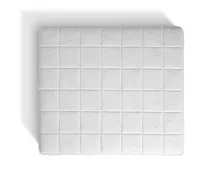
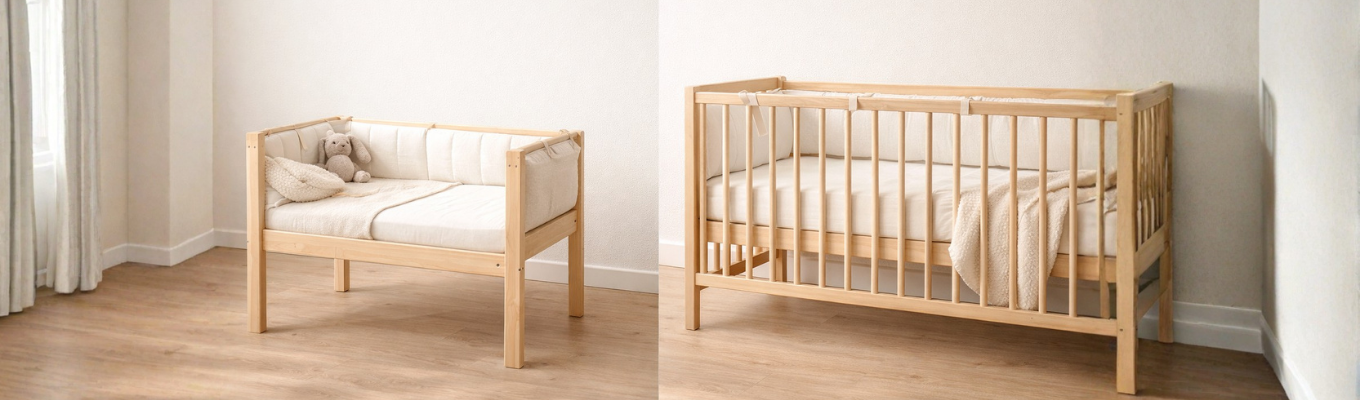
Cot bumpers (and cradle bumpers) are padded protectors designed to cover the inside rails, partially or fully. Their main purpose is to reduce minor knocks against the slats and to make the sleep space look more “cosy”.
Practical note: a well-chosen bumper isn’t “just for looks”. The real difference comes from materials, thickness and fastenings.
Cot bumper: function and use
In a cot with slats, a bumper can be helpful mainly to:
- reduce direct contact with the sides during movement
- create a softer “boundary”
- complete the nursery’s textile set
Cradle bumper: key differences
When we talk about a cradle bumper, a few things change:
- more compact dimensions
- sides are often lower than a cot’s
- the need for a stable fastening, because the space is “tighter” and every element must stay firmly in place
Cot bumper or cot bumpers? (One piece, modular options and types)
Those searching for a “cot bumper” often mean one continuous piece; those searching for “cot bumpers” may be referring to modular solutions or multiple sections. Here are the most common types.
One-piece bumper: when it makes sense
A one-piece bumper (one continuous item) is convenient because it:
- is quick to position
- creates a uniform look
- is often easier to keep evenly “taut” along the side
Ideal if you want a clean look and straightforward installation.
Modular bumpers: pros and cons
Modular bumpers (separate pieces) can be useful because they:
- allow you to cover only certain areas
- adapt better to unusual shapes
- can be washed or replaced individually
On the downside, they require more care when installing: more pieces = more fastenings = more checks. If you’re putting together a complete sleep set, you may also find the guide to choosing a duvet for children and newborns helpful, to coordinate comfort and practicality.
Other popular alternatives (brief note)
There are also “design” options (e.g. braided bumpers or partial protectors). Whatever the style, the point remains the same: choose based on measurements, materials and fastening, not just on shape.
Newborn cot bumper and bumpers for newborns: what to assess before buying
If your goal is a newborn cot bumper (or, more generally, a bumper for the very smallest), it helps to think in terms of a mini checklist: age/stage, breathability, washability and compatibility with the cot or cradle structure.
Baby’s age and development stage
Needs change quickly: in the first weeks a newborn moves very little, while after a few months they become more active. That’s why it’s important to:
- avoid overly bulky options
- prefer models that stay firmly in place
- check regularly that nothing loosens with use
Materials: what to really look for
For bumpers for newborns, materials matter a lot. In general, it’s helpful to prioritise:
- breathable fabrics that feel pleasant to the touch
- padding that keeps its shape without becoming “blocky” or stiff
- well-finished seams that stand up to repeated washing
Practical tip: if a bumper looks beautiful but feels “plasticky”, isn’t breathable or is hard to wash, over time it becomes more of a hassle than a help.
If you’re also looking for a product to complete the set, the duvets for children section includes sizes suitable for both cradle and cot.
Washability and hygiene
A good bumper for newborns should be:
- easy to wash (ideally with clear care instructions)
- quick to dry
- resistant to frequent washing
If it’s removable/with a cover, everyday care is often easier (but it’s not a universal rule: it depends on the model).

Safety: how to choose a cradle and cot bumper responsibly
This is the most important part. A bumper can be a useful accessory only if it:
- is the right size
- is installed correctly
- doesn’t create unnecessary bulk
Correct fastening: ties and anchor points
Check that the model has:
- enough ties or fasteners (not “just two” along the whole length)
- well-distributed fastening points to prevent the protector from sliding down or warping
After installing it, do a simple test: gently push the bumper along the side. If it moves a lot, it needs adjusting.
Thickness and height: what to avoid
In general, it’s best to avoid bumpers that are:
- too tall (that “cover everything” and create a barrier effect)
- too bulky
- overly soft and unstable (they tend to bend and shift)
The goal is a contained protector, not a “giant cushion”.
Common mistakes to avoid
Here are the most frequent mistakes:
- installing it too high
- making loose knots or “temporary” fastenings
- leaving dangling ties or gaps where the bumper can roll up
- not checking ties after washing or moving the cot

Measurements and compatibility: cot bumpers and cradle bumpers
Many returns or wrong purchases start here. Before buying a cot bumper or a cradle bumper, two minutes of measuring is enough.
How to measure a cot or cradle in 2 minutes
Measure:
- internal length (headboard → footboard)
- internal width
- usable height of the inner side
- if possible, also check how the slats are positioned and where you can tie the fastenings
Write the measurements down: they’ll help you choose the correct length and the right type of coverage.
How many sides should you cover?
There isn’t a one-size-fits-all choice. It depends on:
- where the cot is placed (against a wall? in the middle of the room?)
- how much you want to protect
- how practical you want washing to be
Common options:
- 1 side: essential and practical (often against a wall)
- 2 sides: a compromise
- full wrap-around: coordinated look, but requires more attention to bulk and fastenings
Typical sizes (indicative)
Sizes vary by model, but generally:
- a cradle is smaller and needs shorter, lower bumpers
- a cot needs greater lengths and often more fastening points

How to install cot bumpers: a practical step-by-step guide
Installing it well is half the job. Here’s a simple, orderly method.
Correct installation (steps)
- Position: place the bumper inside, along the chosen side.
- Align: pull it taut, avoiding folds and “bulges”.
- Fasten from top to bottom: start with the upper ties and then move to the lower ones (if present).
- Secure, tidy knot: make firm, short knots, without long ends dangling.
- Final test: gently shake the side and check that the bumper doesn’t slip.
Final checklist:
- doesn’t slide when you pull lightly
- no long ties are hanging down
- no sections fold back on themselves
- stays snug against the side even after opening/closing the cot (if applicable)
Cradle bumper: style ideas and matching without losing the practical goal
Yes, looks matter too—and an aesthetic choice can become functional if it’s made well.
Neutral colours vs patterns
- Neutrals: easy to match, clean and timeless look
- Patterns: add character, but it’s best to choose delicate, not overly “busy” designs
Coordinating with sheets and textiles
A cradle bumper or cot bumper can be matched with:
- sheets and mattress protectors
- a sleep sack or blanket
- a canopy or curtain (if present)
FAQ about cot and cradle bumpers
What’s the difference between a cradle bumper and a cot bumper?
The main difference is size and structure: a cradle is smaller and often has different sides, so you need a more compact bumper that can be secured well.
Is a full wrap-around cot bumper better, or just one side?
It depends on the space and practicality. One side is often simpler; wrap-around looks more “complete” but requires more attention to bulk and stability.
How do I know the cot bumper is the right size?
Measure the inside length of the side you want to cover and compare it with the stated product length. If it’s modular, consider the total length of all pieces.
How often should you wash a bumper for newborns?
It depends on use and environment, but it’s best to choose a product that’s easy to wash and dries well, so hygiene stays stress-free.
Which materials are more breathable?
In general, natural fabrics and lighter weaves tend to be more breathable. Always check the composition and care label.
How can I secure a cot bumper so it doesn’t slip down?
You need a model with multiple anchor points and a taut installation, with secure knots and periodic checks (especially after washing or moving the cot).
Conclusion: how to choose the right bumper in 3 points
If you’re considering cradle bumpers or cot bumpers, keep this simple rule in mind:
- Right measurements (measure first, buy second)
- Materials and washability (choose what’s practical, not only what looks good)
- Stable fastening and controlled bulk (install correctly and check periodically)