




How to choose your duvet: the difference between weight and warmth level
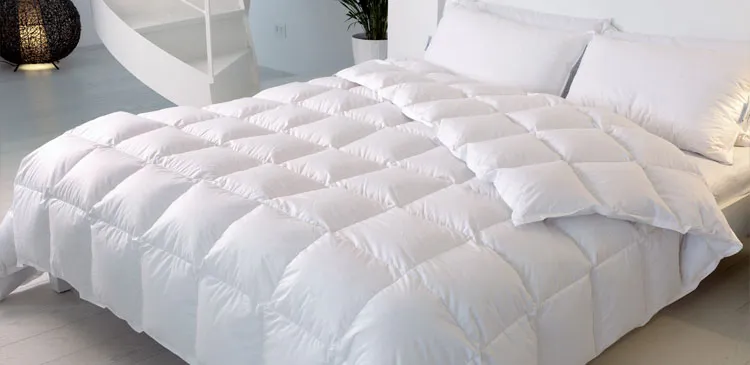
When choosing a new duvet, almost everyone looks at one figure first: the weight in grams.
This is understandable, but it often leads to a mistake: thinking that more weight = more warmth. In reality, to truly understand how warm a duvet is, the most important factor is not the weight, but its warmth level.

In this article we explain:
- what the warmth level is and how it is indicated (e.g. Cold Winter, Classic Winter, Mid Season, Trio 4 Seasons);
- what the weight of the duvet means and the difference between total fill weight and g/m²;
- why two duvets with the same warmth level can have different weights;
- how to read the product page correctly and debunk the main myths.
What is the warmth level of a duvet?
Definition of warmth level
The warmth level is a thermal comfort scale: it indicates how well the duvet retains body heat under certain conditions (room temperature, season, personal sensitivity), not how many grams it weighs.
In DaunenStep duvets, the warmth level is expressed, for example, with the following labels:
- Mid Season – light warmth, ideal for mid-seasons or mild rooms;
- Classic Winter – medium warmth for city winters or well-heated bedrooms (around 18–22 °C);
- Cold Winter – high warmth for harsh winters or poorly heated rooms (below 18 °C);
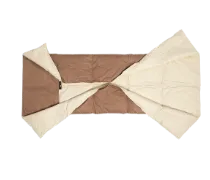
- Trio 4 Seasons – 4-season solution: two duvets that can be fastened together (one lighter + one warmer) to cover all seasons.

The warmth level therefore tells you under which conditions that duvet is designed to help you sleep well, without feeling cold or overheated.
What the warmth level depends on
The warmth level does not depend only on the amount of filling, but above all on:
-
Type of filling
– goose down
– small feathers (heavier, less insulating than down clusters)
– synthetic fibres with a “down effect” -
Quality of the filling
For natural down, the fill power is often used: the higher it is, the more voluminous and insulating the down cluster. At the same warmth level, a duvet with high fill power can be lighter. -
Construction of the duvet
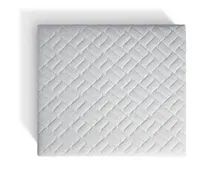
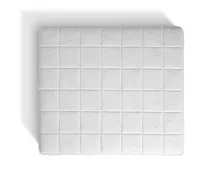
Closed baffle boxes, box stitching and more or less breathable outer fabrics all help to retain warmth evenly.
The weight of the duvet: what it really means
Total weight vs filling weight
When talking about the “weight of the duvet”, it is important to distinguish between:
- Total weight: filling + cover fabric + any bindings and finishes;
- Filling weight: only the grams of down/fibre inside.
To compare two products, it makes most sense to look mainly at the filling weight, not at the total weight of the duvet.
Total fill weight vs grams per square metre (g/m²)
This is where many misunderstandings arise:
-
Total fill weight
This is the total grams of filling inside the duvet (e.g. 1,000 g of filling). -
Grams per square metre (g/m²)
This indicates how many grams of filling there are per square metre of surface (e.g. 200 g/m²).
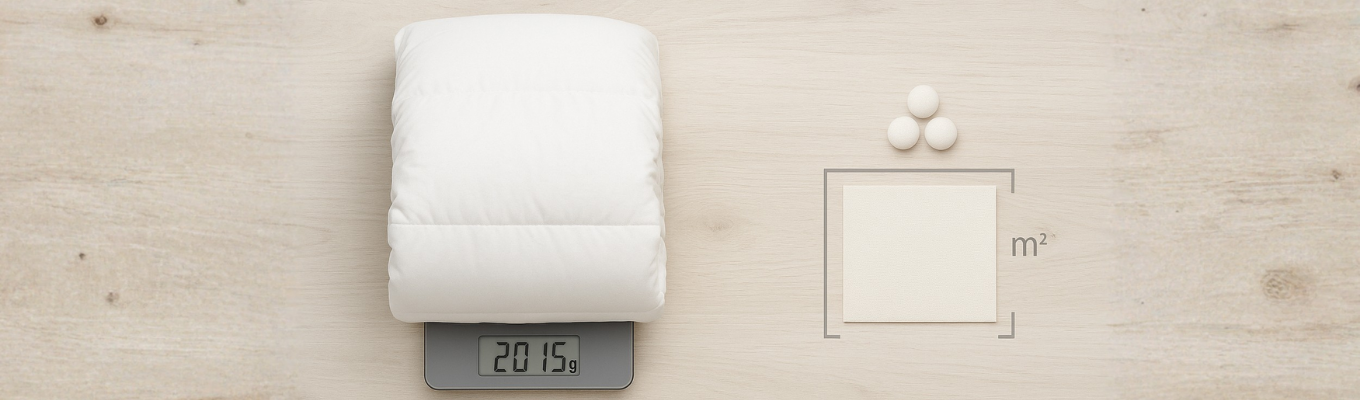
To compare two duvets properly, it is much more accurate to use g/m², because they:
- take the filling into account in relation to the surface area of the duvet;
- allow you to compare duvets of different sizes without being misled by the total grams alone.
How the weight changes according to the size
At the same g/m² value, a duvet:
- single size will have fewer grams in total;
- double size will have more grams, simply because it is larger.
A simplified example: if a duvet offers 200 g/m² of filling, the single size model will have a certain total weight in grams, while the double size will have many more grams, yet both guarantee the same warmth level per person.
Same warmth level, different weights: why it happens
The efficiency of the filling
Two duvets both classified, for example, as Classic Winter can have different weights because:
- a duvet with a more efficient filling (e.g. higher fill power) reaches the same warmth with fewer grams;
- a duvet with a less efficient filling needs more material to offer the same warmth level.
The result is the same thermal comfort, but one duvet feels noticeably lighter on the body.
Fabric and construction
The way the duvet is constructed also plays a role:
- more or less dense and breathable fabrics;
- closed boxes that prevent the filling from shifting;
- stitching that reduces “cold bridges”.
All of this can improve insulation without necessarily increasing the filling weight.
What you can expect as a customer
It is perfectly normal to find two winter duvets with different fill weights:
- both will keep you comfortably warm in the same type of environment;
- the lighter one will generally feel more premium and more comfortable, because it weighs less on the body while maintaining the same warmth level.
What to look at on the product page when comparing duvets
Key data to compare
When you read a product page, focus on:
- Declared warmth level
e.g. Mid Season, Classic Winter, Cold Winter, Trio 4 Seasons. - Grams per square metre (g/m²)
This is the key value to understand the “dose” of filling in relation to the surface area. - Total fill weight
This can be useful, but only when considered together with the size of the duvet. - Type and quality of the filling
– percentage of down/feathers;
– fill power for natural down;
– type of fibre for synthetic fillings. - Duvet size
Single, one-and-a-half size, French size, double, extra double: the size changes the total grams.
How to read the numbers correctly
Typical mistakes:
- looking at only the total grams without taking the size into account: a double duvet will always have more grams than a single one;
- comparing duvets made of very different materials based solely on grams;
- ignoring the warmth level: in a well-heated room, a Cold Winter duvet may be too warm, even if it seems like a “good deal” in terms of grams.
Myths about duvet weight and warmth
Myth #1: “More grams = more warmth”
False: what matters is how efficient the filling is. A high-quality duvet provides the same warmth with less weight.
Myth #2: “A light duvet cannot be warm”
With premium fillings and high fill power, you can achieve a high warmth level with very low weight.
Myth #3: “Synthetic duvets are always heavier than natural ones”
There are lightweight, high-performance fibres with a down-like effect: the comparison should be based on g/m² and warmth level, not on preconceptions.
Myth #4: “To avoid feeling cold I must choose the duvet with the highest grams”
The risk is that you get too hot and sleep poorly. It is better to choose the warmth level suited to your room temperature and to how you personally feel the cold.
How to choose the right warmth level for you

According to the room temperature
- Poorly heated rooms / homes in cold areas
Below 18 °C: a Cold Winter duvet is the better choice. - Moderately heated rooms (18–22 °C)
In many cases, a Classic Winter is sufficient. - Very warm rooms or mid-seasons
A Mid Season duvet is more suitable; with a Trio 4 Seasons you can use only the lighter duvet when it is warmer and fasten both together when winter arrives.
According to how you feel the cold
- If you are very sensitive to the cold, choose a slightly higher warmth level than what the room temperature alone would suggest.
- If you tend to feel hot easily, it is better not to overdo the warmth level: an overly warm duvet leads to sweating and restless sleep.
According to use and season
- Mid Season: for mid-season, cool summer nights, very warm bedrooms.
- Classic Winter: for winter in the city or well-insulated homes.
- Cold Winter: for harsh winters, cold rooms, homes in the mountains.
- Trio 4 Seasons: flexible solution if you want a single set that covers the whole year.
FAQ about duvet weight and warmth
How many grams should a winter double duvet have?
There is no single “right” number of grams for everyone. It depends on: g/m², duvet size, type and quality of the filling and warmth level (Classic Winter, Cold Winter, etc.). Always look first at warmth level + g/m², then at the total grams.
Is it better to look at grams or at the warmth level?
For the initial choice, the warmth level is more important, because it links the duvet to your room temperature and your needs. The grams are useful to compare similar models, but not to make the first decision.
Why is my duvet light but still very warm?
It probably has a high-quality filling (down with high fill power or very high-performance fibres) and a good construction: it retains warmth with less weight.
Can I compare different duvets based on grams only?
Better not. You should at least consider g/m², size, type of filling and warmth level. Looking only at total grams can easily be misleading.
What does g/m² mean for a duvet?
It is the amount of filling (in grams) per square metre of surface. It is the most useful value to objectively compare different duvets, especially when they come in different sizes.
Related products